
Are unicorns real?


If you lined up every non-inside mid and asked them “do you want to rotate through the midfield next season?”, every single one of them would gleefully accept. Small forward, medium defender, even KPDs and KPFs seem to secretly think they’re a smokey for the Brownlow if the coach would only throw them into the coalface. If I’d only been a bit bigger in under-18s—a bit smaller—if I’d improved my tackling earlier—if the coach would just try me out—it’s that fantasy we all had as a seven year old where your team goes down a player, and the coach has to resort to pulling a fan from the stands and suiting them up.
But much like a seven year old girl in kid-sized jersey nailing the winning goal in Fremantle’s first grand final, this is a little bit silly.
Inside mids earn the right to be inside mids. Selection for inside midfield filters for raw strength in the contest, skills under pressure, elite endurance—traits which make an AFL player successful in most positions. A good rule of thumb: the better you are at AFL, the more likely you are to be played as an inside midfielder. By my count, 45 of the top 100 paid players were inside mids, and this is excluding Shai Bolton types who spend healthy chunks of the game around stoppage. Inside midfielders are disproportionately expensive for good reason: clearance wins usually translate to actual wins (if you put aside whatever the fuck was happening in 2024 with Freo’s abject failure to capitalise on i50s). Only the very upper echelon of key position players can compare pay stubs. And for a KPP, skills alone aren’t enough; you need to win the genetic lottery of height.
Height simply doesn’t matter in the same way for midfielders: well-deserved dual Brownlow medallist Lachie Neale is only 177cms; not-quite-as-deserving dual Brownlow medallist Patrick Cripps is up at 195cms.
But if you’re 199cms and a terrific overhead mark, not to mention a neat kick for goal, every coach in the league would plonk your magnet in a KPP role without a second thought. The combination of height and football skills makes you a precious commodity. And “KPP by default” is where we find Luke Jackson at the start of 2025.
Back when Luke Jackson was recruited from Melbourne in 2022, the pitch from Freo was an innovative mix of forward, ruck, and midfield time. Here, we first heard whispers of a “unicorn”—a player tall enough for KPP roles, and skillful and agile enough to impact at ground level like the game’s top midfielders.
For Luke and his management, there should have been flashing red warning signs: on paper, Jackson was replacing Rory Lobb who had been playing a traditional 80-20 forward/chop out ruck split; over the last decade, Freo have been so bereft of key forwards they have resorted to, inter alia, Griffin Logue, Nat Fyfe, Shake Kersten. If you’re tall and you can take a decent mark, Freo’s selection committee locks you into the forward line and throws away the key. (Ability to kick straight unfortunately not a prerequisite.) Whatever sweet nothings Freo’s list management had been whispering during the trade talks, by r1 of 2023 Luke Jackson was expected to play as a fairly traditional ruck-forward.
The mythical unicorn receded into the mists, like a movie with a unicorn in it. I don’t have an appropriate metaphor here; I only watch sad war movies.
Luke Jackson is an eminently serviceable forward. He is an exceptionally good all round AFL player and can adapt to new positions—perhaps not one of the game’s great tactical thinkers but far cannier than he is given credit for. If you account for the ruck stints, he’s put up healthy yearly goal tallies since arriving at Freo: 22, 21, 20.
In addition, he is an exceptional second ruck. When Freo go up against a team without two rucks, Jackson dominates whichever unfortunate forward pulls the short straw. If Darcy ends up on the bench or resting forward a few extra rotations, Jackson can also hold his own against first choice rucks. His capacity to win the ball outright and function as an extra mid around the contest made him a damaging weapon at crucial junctions.
A good forward, a great secondary ruck. But not exactly the unicorn we were promised, that Luke Jackson clearly believes he can be.
So, have Freo made a terrible error recruiting two bona fide first choice rucks? Well, no.
Due to Darcy’s injury struggles, we’ve also seen a lot of Luke Jackson, sole ruck. Whenever Luke Jackson plays sole ruck against a ruck who is not very good, we get a round of reactive media coverage about how Freo should send Darcy to the farm like the aging family golden retriever. (The “farm” in question not a veterinarian crematorium, but rather Geelong Football Club.)
And then Jackson goes up against a good ruck and everyone goes quiet.
Jackson gets exposed by a big-bodied tap ruck, particularly as the game wears on and his aerial capacity degrades with exhaustion. Clearest examples of this were the 3 losses to end Freo’s finals chances in 2024, or the 2025 r2 Sydney game where Grundy won hit-outs to advantage 11-5 despite attending far less ruck contests. It simply doesn’t matter how good your fitness is: jumping 100cms in the air is harder work than jumping 50cms and shoving your opponent out of the way. Every mobile sole ruck fades out in the 4th quarter. There’s also something to be said for the tap accuracy possible holding your ground vs. Jackson having to wildly propel himself up into the stratosphere. Against experienced ruckmen, Jackson doesn’t put up many hit-outs to advantage on the stat sheet, and the eyeball test is even less flattering. In Freo’s demoralising 2025 r8 loss to St Kilda, Jackson got mugged by Marshall in direct match-ups. Jackson could get shown up even against 2nd tier rucks like Marc Pittonet, as pointed out in the first two clips by the Freo fanbase’s best analyst, Smurf_x.
I don’t see a way to fix this without compromising Jackson’s amazing aerobic capacity and aerial skills which rely on his springy, athletic build. If he was playing as a sole ruck long-term, he’d probably pack on a few kilograms—and thereby rob himself of his moon gravity marking and his sneaky side-step through stoppage. Maybe improvement on pure tap work will happen with age; Jackson is only 24, which is pre-pubescent in ruck years.
(I’m a bit skeptical about how much the ruck rule changes will actually reconfigure stoppages—it certainly won’t hurt Jackson’s ruck style, but I don’t expect him to suddenly dominate hit-outs.)
For now, the real magic of Luke Jackson’s rucking comes against a pinch-hitter who doesn’t want to be there. Teams don’t like fielding two rucks: few teams have two good rucks on their list; and even if you do have a spare, your second ruck ends up spending big chunks of the game resting forward where you could be fielding a more specialised KPF. But the other option is to select a single ruck, who has to maximise their ruck contests attended and by the 4th quarter can barely jump. And when they stagger to the bench for respite, the pinch-hitter will get smoked by an unfatigued Luke Jackson.
(As an aside, I’d bet this structural selection advantage is why St Kilda was quite comfortable playing hardball with Marshall. Marshall and De Koning are both agile enough to do okay in the forward line.)
Regardless of the tactical advantages to Freo, there were signs that Luke Jackson preferred sole ruck to being a part-ruck-mostly-forward. For starters, Jackson said as much in a r11 post-game interview with Ryan Daniels (much to the chagrin of dual ruck believers). Rumours swirled of a trade back to Melbourne, as the Demons sought a successor for Max Gawn.
And then Patrick Voss happened. From delisted SPP train-on, to Freo’s rookie list, to tearing apart the MCG off his own boot. Freo have found three young key forwards who take marks, kick goals, run defensively and structurally. Crucially, Voss and Treacy apply ferocious forward half pressure—the drawback of too many talls can be easy f50 exits, with less agile KPFs failing to prevent damaging rebound like a small pressure forward would. It’s difficult to statistically evaluate KPF defensive pressure because any KPF who pinch-hits in the ruck will always end up with an inflated tally of pressure acts, tackles, tackles i50 (far easier at stoppage when you could throw a blanket over a dozen players). In a slapdash attempt to isolate the confounding factor, I’ve used the incredible wheeloratings.com to graph tackles and pressure acts for KPFs with less than 10 ruck contests per game:
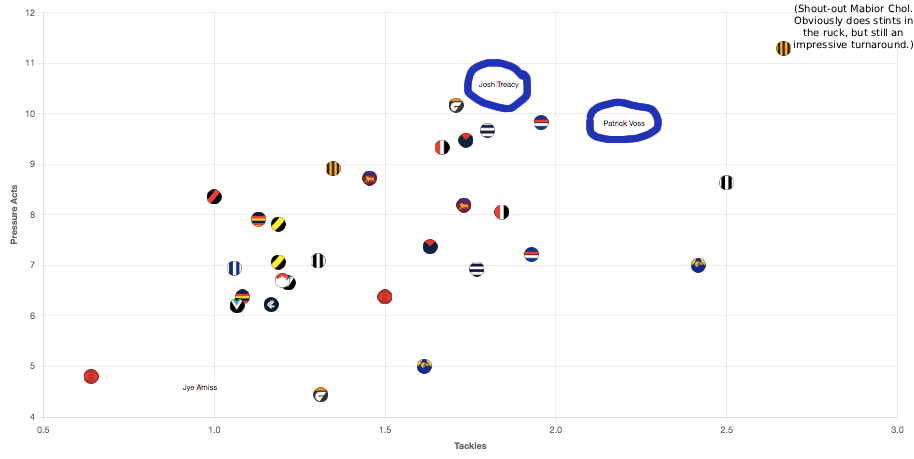
(Ignore Jye Amiss down in the bottom corner there, there must be some sort of software error.)
Making three KPFs work is one thing—you don’t need four. Luke Jackson was, for the very first time, surplus to requirements in Freo’s forward line. And with Sean Darcy back, his adventure as sole ruck was over.
Finally, Freo were in a position to live up to their recruiter’s promises. With Darcy in the ruck, Jackson lined up with his fellow inside midfielders around the center square.
So how was Luke Jackson, inside midfielder? Not quite the full unicorn. Sparkles here and there.
There were games where Jackson stamped his influence specifically as a midfielder: 3 Brownlow votes, 27 touches against Carlton; 2 Brownlow votes, 23 touches against Port the week after.
But there were also moments where he looked like a fish out of water—or worse, a seven year old lining up for a deciding goal.
In the excruciating r23 loss to Brisbane Jackson kicked 1.1 when he rested forward, but around stoppage he had just 11 touches, and 9 hit-outs. Jackson was nowhere near worst on for Freo, but this is still a poor return on 52% center bounce attendance. Jackson could get burned when matched up on more experienced midfielders like Dunkley or McCluggage, who had far more dexterity and evasive craft than the rucks Jackson was used to managing around stoppage. Even in that 3 Brownlow game against Carlton, Jackson’s on-and-off-again match up Patrick Cripps had 36 touches, and probably would have pinched the 3 votes had Carlton won the game.
There is no doubt in my mind that Freo will persevere with Jackson in the midfield. For one, Luke seems to want to play as a midfielder. Jackson’s contribution as 2nd ruck is such a structural asset to the team that if he asked to rotate into the Dokka the Quokka mascot suit on the boundary Freo would probably let him.
Secondly, and this is crucial: he might be really good at it.
My previous post about the 2021 draft class was pointing out an area of internal improvement for Freo. This post might seem a bitter screed against Luke Jackson, like I believe he has ransomed his way into the midfield. It is not. This is what optimism looks like, for me.
As mentioned, this midfield time only became available when Sean Darcy returned from injury to cover the number one ruck, while simultaneously our newly unearthed KPF was coordinating well in our forward line. All the retooling for this inside role happened during in-season training sessions, concurrent to preparation for upcoming ruck opponents and forward rotations; most non-emergency positional switches come after a full pre-season learning the craft. Like a young mid getting a tagging role to cut their teeth, Luke Jackson looked most damaging when he was playing on a seasoned ball-winning opponent who could bring him to the sherrin, at which point Jackson’s instinctive hunt would take over and he’d often end up winning the clearance. To me, this suggests the skills are there but the craft isn’t. Craft that right now in pre-season 2026, Jackson will be revising with the midfield group.
Luke Jackson will play more inside minutes in 2026 than the back half of 2025 (fantasy footballers, you heard it here first). Sean Darcy had an injury interrupted pre-season and season proper and his Time on Ground % was in the low 60s, whereas he’s been over 80% ToG in previous full seasons. If all goes well on the injury front, we’ll see him back at 80+% in 2026, and that extra ~20% will be in the ruck. Jackson’s ToG will still include resting forward to cover whichever tall forward needs a break. Let’s say 25% ruck (with a few rests forward for Darcy too), 25% forward. That leaves a big chunk of Jackson’s standard ToG where Darcy will be in the ruck and there will already be 3 KPFs roaming the forward line; Freo don’t need another tall clogging up leading lanes. And you don’t leave Luke Jackson sitting around on the bench. That last 30ish% of gametime will be in the midfield.
Patterns will become more instinctive, conditioning for repeat sprints will improve, and Jackson will begin to capitalise on his strength advantage on traditional mids.
We’re not including Jackson in the midfield like you’d buy your kids McFlurries on a road trip to shut them up. Serong, Brayshaw, Bolton, Switta, Reid (and O’Meara, if he’s b23 in 2026) are all on the Lachie Neale end of the midfield height spectrum. Over the last few seasons, big-bodied mids like Bontempelli and Cripps have reliably torn Freo’s vertically challenged midfield to pieces. Having Jackson available to outmuscle them at contest solves that lingering headache. Here is a clip (thanks again to Smurf_x) of Luke Jackson doing what no other Freo mid could do: blocking out Patrick Cripps, reaching up over another ruckman’s grasp, dishing the ball off to the best-poised distributor in an unmanned Bolton.
And this hasn’t even touched on Jackson’s biggest strength: his marking. He outmarks his ruck opponents around the ground; what hope does a conventional inside midfielder have against him? As Fremantle settled into their new, tall structure we started to see 70m-to-the-center-square kicks bitten off out of defence, because there was always someone tall enough to at least halve the contest. Everywhere Jackson goes with his midfield opponent, floating forward or working back into defence, Freo gain a KPP-worth of aerial advantage.
So, are unicorns real? In 2026, we’ll find out.
Another great read! Keep them coming. 💜
Another fantastic piece deserving of a greater audience. I look forward to your next one